How to improve your reaction time for gaming and beyond


Key takeaways:



- Your reaction time can be trained to be faster.
- Action video games cause decision time to decrease by up to 25% without losing accuracy.
- Sleep, diet, and hydration are all very important when it comes to reaction times.
Picture yourself playing your favorite PvP shooter. An enemy player pops around the corner and you have approximately 200ms to make a decision. Do you dodge left? Spray back? If you take that extra millisecond you have just got fragged and are now face planting on the ground watching the replay.
Reaction time is how long it takes you to go from perception to response, but did you know you can train yourself to react quicker?
By learning how reaction time works inside your brain and what type of reaction time matters for you as a gamer you can train to be more effective at decreasing your reaction time. We will be going over both of these subjects.
What is reaction time and why does it matter for gamers?
Reaction time is how long it takes you, from your brain receiving a signal to creating a physical response. For most of us humans that window sits around 150-300 milliseconds. Your brain is slowest at processing information from your eyes, taking around 250ms on average. Sound is processed at around 170ms and touch around 150ms.
Why should gamers care? Because almost everything you respond to in a game is visual.
- A screen flash
- An enemy movement
- A HUD alert
There are two distinct reaction times, and knowing which one matters for gaming makes all the difference.
Simple reaction time is one stimulus, one response. A light turns green, you press a button. The average is around 253 milliseconds.
Choice reaction time is multiple stimuli, multiple possible responses, and you need to pick the correct one. That average jumps to roughly 369 milliseconds, about 115ms slower. The increase follows a principle called Hick’s Law: more options for your brain to sort through means more time to choose.
Gaming almost always involves choice reaction time. You’re not clicking one button when a light flashes. You’re reading the situation, filtering several possible moves, and selecting the right one under pressure. Pro esports players might score 150 to 180ms on simple reaction tests, but their real edge is in how fast they process complex decisions.
Why gamers have faster reactions
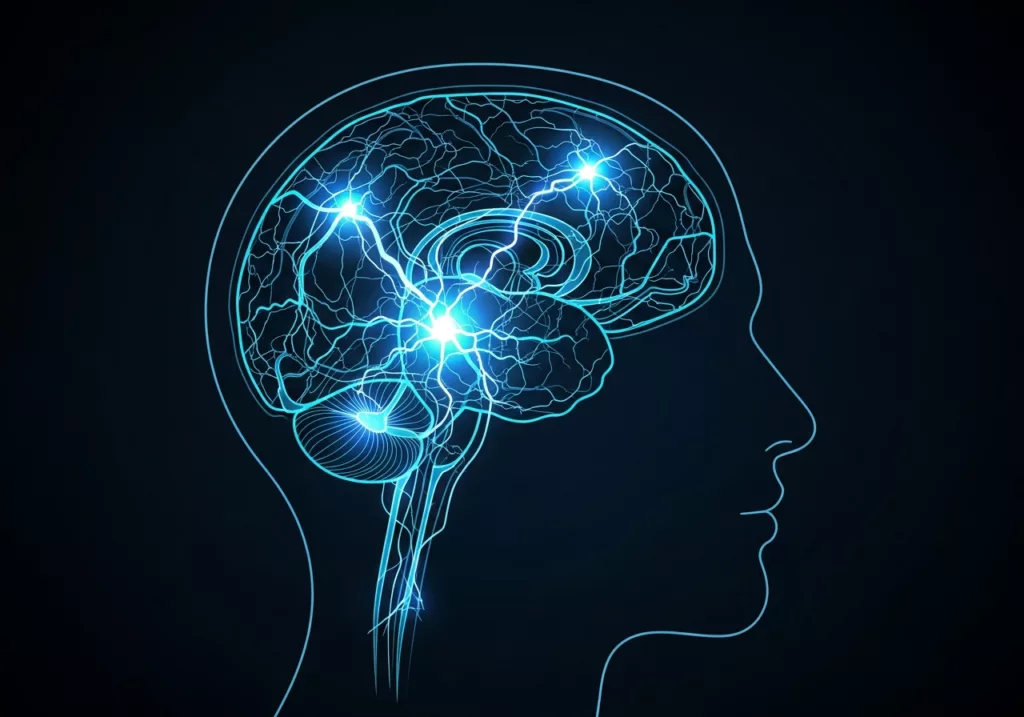
Gamers make decisions faster because practice makes their brains better at understanding visual/auditory cues. Connections in the brain develop with training, allowing gamers to reach a cognitive threshold for decision-making faster.
A 2009 study split non-gamers into two groups.
- One played 50 hours of fast-paced action games
- The other played slower, methodical games.
The action gamers made decisions 25% faster with no loss in accuracy. They got better at collecting visual and auditory cues efficiently. Both groups needed the same amount of evidence to decide. The action gamers just gathered it quicker.
Aging and reaction times
Your reaction time does slow with age, but experience can compensate for it.
A PLOS ONE paper found the average cognitive-motor reaction time of gamers begins to slow around age 24. People cite this as proof that anyone over 25 is doomed to diminished performance. But the results are far more nuanced.
Senior players made up for losses in brute reaction speed with smarter decision-making, more purposeful mouse movements, and increased lookahead. You do slow down a bit, yes. But you learn to focus your attention more efficiently, saving those precious milliseconds back.
Exercises to improve your reaction time
Physical drills
Physical training works here because it forces your brain to process unpredictable stimuli and coordinate a motor response on the fly. A few drills are worth your time:
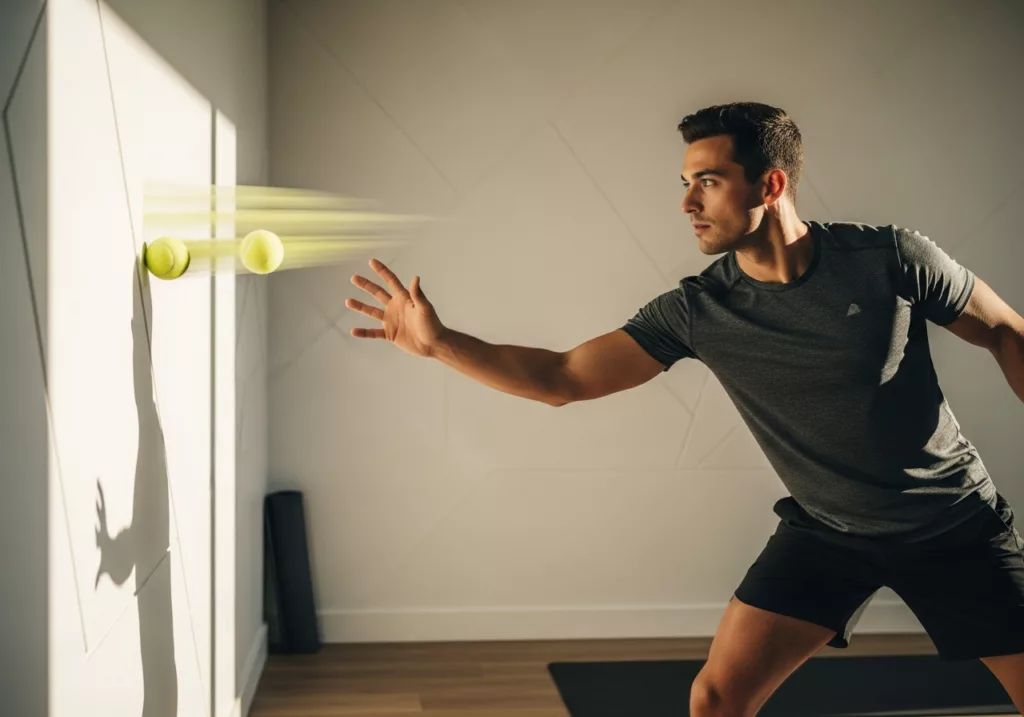
Tennis ball wall drill. Throw a tennis ball against a wall six feet away at various angles. Catch it with one hand. When you’ve mastered that, catch two at once. Fitness coaches have been using this drill for years because you can’t beat how cheap it is, how portable, and how infinitely trainable. It also develops hand-eye coordination in a scenario that maps almost perfectly to looking at rapidly moving objects onscreen.
Agility ladder with random cues. Do drills you’d normally do with an agility ladder, but have a partner call out random changes that you have to immediately react to. Reverse directions. Do the opposite foot pattern. Stop. The ladder itself is great for coordination. Throw in verbal cues you have to listen to and obey, and you’ve made it into a dynamic decision-making drill much more similar to what happens in game.
Sprint-and-react. Sprint for 10-15 meters before reacting to a directional cue by your partner who will randomly point left, right, or behind. Quick and explosive. Performing them fatigued is important as it simulates reacting quickly when your mind is under duress, just as it would be during a late-game scenario.
Mental/In-game Exercises
Aim trainers (AimLabs, Kovaak’s FPS Trainer) are going to be the most beneficial for improving raw mouse to target reaction time. They isolate the skill and allow you to quantify your progress. Use them for 10-15 minutes at a time, especially before queueing up for a match.
Online reaction tests are useful for establishing a baseline but not great as ongoing training tools. Clicking one button when a color changes mostly trains simple reaction time. Your gaming improvement comes from training that involves decision-making, not just raw clicking speed.
Different game genres train different types of reaction time. Fast-paced shooters drill simple RT and target acquisition. Strategy games and RPGs train decision speed under time pressure. PvP action games, where you’re reading an opponent’s behavior and picking counters in real time, are some of the best training for choice reaction time and anticipation.
If you would like to try out free-to-play games that put you in high-speed PvP scenarios, Mech Arena is a solid pick for building this kind of reactive decision-making.
Mindfulness and mental training
Meditation might sound out of place in an article about reaction speed. The research supports it, though. Studies have found that meditation is overpowered in improving both auditory and visual reaction time while increasing alertness.
There’s no need to sit down for a 30 minute session before you play either. An ideal pre-game warm-up would look something like this:
- 5 minutes of box breathing
- Breathe in for 4 counts, hold for 4, breathe out for 4. This clears your head.
- Quick round of an aim trainer
Upon completing these two steps, you can queue up for a match.
Lifestyle factors that set your reaction time baseline
Sleep
Don’t skimp on sleep. Lack of sleep is the quickest way to sabotage your reaction time. Six hours per night instead of eight still slows your cognitive processing speeds, measurably.
Hitting the recommendation of seven to nine hours of sleep should be your goal, if you care about performing optimally.
Nutrition and hydration
Your brain requires very specific conditions to operate optimally. Consuming Omega-3 fatty acids (salmon, walnuts, flaxseed) helps maintain your neurons’ membrane health which has been shown to decrease signal travel time between neurons. Blueberries, dark leafy greens, and other antioxidant-rich foods help protect your brain from oxidative damage.
Lastly, stay hydrated. Most gamers ignore this. Dehydration as little as 1 to 2% body fluid loss slows your reaction time and ability to focus. Water should be by your computer at all times. Not energy drinks. While caffeine can decrease reaction time in the short term, you quickly build a tolerance for it.
Hardware and setup
Your setup affects how much of your physical reaction speed actually reaches the game. It’s not training, but it’s free performance.
Monitor refresh rate is the biggest factor here.
- At 60Hz, your monitor redraws the image every 16.7 milliseconds.
- At 144Hz, it does so every 6.9ms, delivering visual information to your eyes about 10ms sooner.
That’s approximately 5% of average player reaction time. Doesn’t sound like much on paper, but it’s pure speed you gain by upgrading your display.
Peripheral input lag also adds up. You should prefer a high polling-rate gaming mouse (1000Hz) and a mechanical keyboard with low actuation to reduce potential input delay to the minimum.
In-game settings matter more than people think. Lowering graphics settings to maintain a higher, more stable frame rate cuts input-to-screen delay.
Competitive players sacrifice visual quality for responsiveness all the time. If you’re dealing with broader lag and latency issues, optimizing your network and display settings can claw back dozens of hidden milliseconds.
How to build a reaction time training routine
A typical reaction time training should be 15-20 minutes long and include multiple formats.
- Spend 5 minutes doing something physical (wall drill w/tennis ball).
Spend 10 minutes alternating between an aim trainer and some sort of game you play competitively. - Spend 5 minutes mentally noting what felt good and where you felt slow.
Besides working on your reflexes, you should also practice anticipation. Watch replays of your games. Learn enemy tells. Create a mental heuristic of what will most likely happen given a certain scenario.
Players at the top levels aren’t always the ones with the “quickest reactions.” They already know what’s coming. They recognized a pattern and preloaded the motor response.
Improving your reaction time for gaming FAQs
What is the average reaction time?
Can you improve reaction time at any age?
Is 100ms reaction time good?
Do video games improve reaction time?