How to Improve at RPG Games: Build, Gear, and Strategy


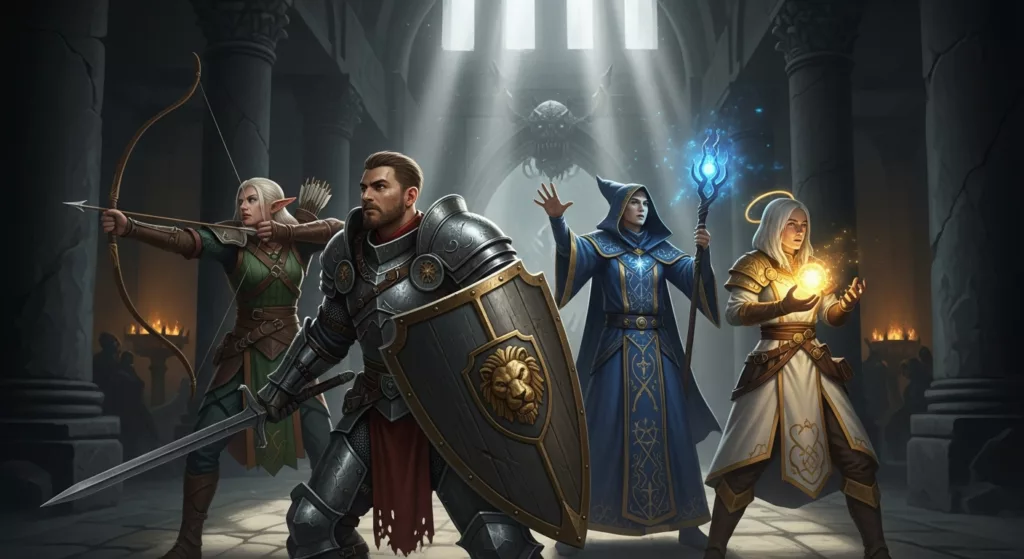
Getting better at an RPG is less about luck and more about three skills: build, gear, and strategy.



A practical framework for getting better at any RPG, from the maths of stats to the art of team-building.
To improve at RPG games, focus on three things in order: your build (the stats and skills you invest in), your gear (the equipment and set bonuses you choose), and your strategy (how you use your characters in battle and as a team). Most players plateau because they pour resources in randomly. Getting better is mostly a matter of making deliberate, informed choices in those three areas, and learning to test and adjust rather than guess.
This guide lays out a framework that works across almost any role-playing game, whether you play sprawling single-player RPGs, turn-based collection RPGs, or anything in between. The specific menus differ from game to game, but the underlying principles do not. We will go through each of the three pillars, then pull them together with a worked example and a repeatable routine you can apply to your own roster.
| The core ideaA character is not strong because of one big number. It is strong because its build, gear and role all point in the same direction. Improving means aligning those three, not maxing them separately. |
Pillar 1: Build, invest with intent not evenly
Your build is the foundation: the stats, skills and progression choices that define what a character is good at. The single most common mistake new players make is spreading their investment evenly across everything, trying to be good at it all. In most RPGs this is a trap, because enemies scale aggressively and a character good at nothing in particular gets left behind.
Know your core stats
Almost every RPG is built on a small set of core stats. The names change between games, but the archetypes are remarkably consistent: a power stat that drives your main damage, a health or vitality stat that keeps you alive, a speed stat that decides how often you act, and accuracy and resistance stats that govern whether effects land or are shrugged off. Before you invest anything, work out which of these your character actually needs for its job. A damage dealer lives and dies by power, crit and speed; a healer cares far more about speed and survivability than raw attack.
| Universal rule: percent beats flatWhere a game offers a stat as either a flat value (+200 attack) or a percentage (+15% attack), the percentage almost always scales better as your character grows. Prioritise percentage stats on your gear and upgrades; treat flat bonuses as minor extras. |
Min-max, but don’t break your character
Min-maxing means pushing your most important stats as high as possible while letting the irrelevant ones fall away. A ranged spellcaster has little use for melee power, so that becomes a dump stat. This focused approach almost always outperforms a balanced spread, because it lets you hit the thresholds that matter. The caveat is survivability: a character that deals enormous damage but dies in one hit is not optimised, it is fragile. The one stat almost no build can ignore is health or its equivalent, because staying alive is the prerequisite for everything else.
Understand soft caps and breakpoints
This is where most guides stop and most players go wrong. Stats rarely scale in a straight line. Two ideas matter here. A soft cap is a point beyond which each extra point of a stat gives much less benefit than the one before, so stacking past it is wasteful. A breakpoint is the opposite: a specific threshold worth hitting exactly, because crossing it unlocks something concrete, such as reaching the speed needed to take two turns to an enemy’s one, or hitting the crit rate where a key ability always triggers.
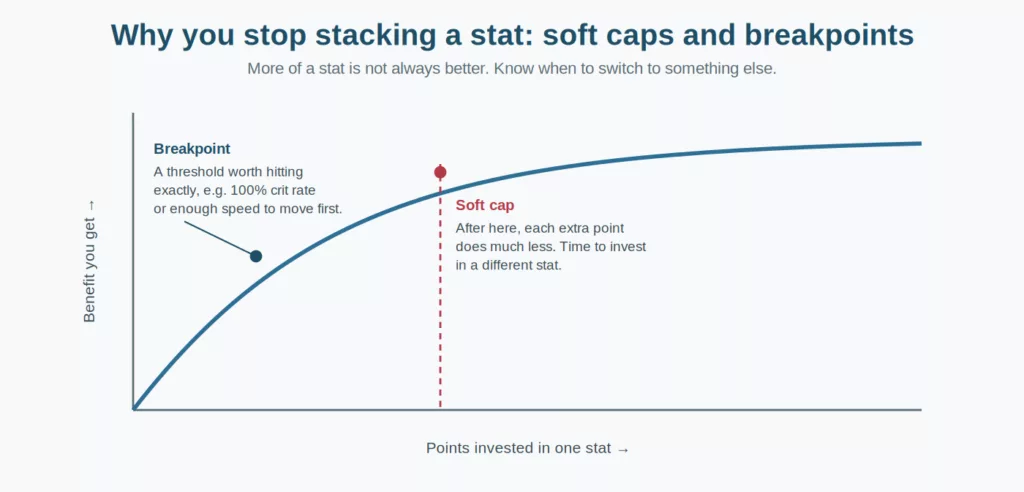
Past a soft cap, keep stacking and you waste resources. Hit a breakpoint exactly, then move on.
Learning the soft caps and breakpoints of your favourite game is the fastest single way to improve a build. It tells you when to stop pouring resources into one stat and switch to another, which is exactly the decision that separates an efficient build from a wasteful one. Many games have community-maintained guides that list these thresholds, and they are worth seeking out.
Pillar 2: Gear, set bonuses over raw numbers
Once your build defines what a character should be, gear is how you get it there. Equipment is where a lot of a character’s final power comes from, and it is also where players waste the most resources. The key shift in thinking is this: a great build is not the gear with the biggest numbers, it is the gear that serves the character’s role.
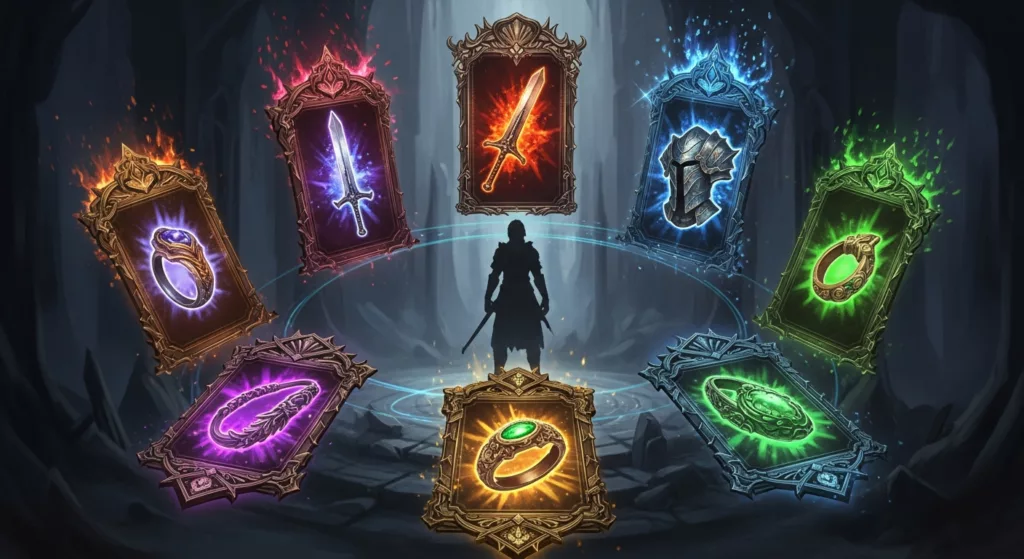
Gear is where a build comes together. The aim is coherence, not the highest numbers on each slot.
Prioritise the right stats for the role
Each role wants different things from its gear. A damage dealer chases crit rate, crit damage, attack and speed. A tank wants health, defence and enough speed to act in time. A support prioritises speed and accuracy so its buffs and debuffs land first and reliably. A healer wants speed and survivability above all. Gearing a character with stats that do not match its job, such as piling attack onto a healer, is the most common way players hold themselves back without realising it.
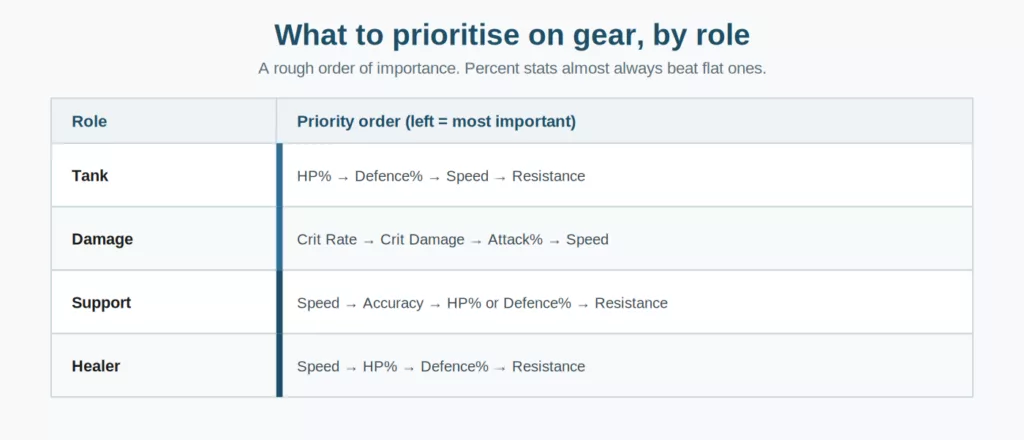
A rough priority order by role. Adjust to your game, but the logic holds widely.
Chase set bonuses, not just stat sticks
Many RPGs group gear into sets that grant a bonus when you equip enough pieces of the same type, such as a speed set that boosts how often you act, or a set that lets you ignore some of the enemy’s defence. A well-chosen set bonus that aligns with a character’s role is frequently worth more than a piece with slightly higher raw stats. When you plan a build, decide which set you are aiming for first, then fill in the individual stats around it.
| Discipline saves resources: don’t over-invest in mediocre gearMost games let you upgrade gear in stages that reveal its bonus stats as you go. Upgrade a piece partway, check whether the bonus stats are useful, and only pour resources into fully upgrading the ones that roll well. Walking away from a mediocre piece is a skill in itself. The resources you save go into gear that actually performs. |
Mind the secondary stats
The visible main stat on a piece of gear is only half the story. The smaller secondary or substats are often what separate an average piece from a great one. A weapon with the right main stat but four useless substats can be worse than one with a slightly lower main stat and four perfect ones. As you progress, you stop chasing rarity for its own sake and start reading the substats, which is a clear sign your gear sense is maturing.
Pillar 3: Strategy, play the team not the character
Build and gear make individual characters strong. Strategy is what turns strong characters into wins. In most RPGs, and especially in team-based ones, the biggest gains come not from any single character but from how they work together and how you use them in the moment.
Build a balanced team, covering every role
A common beginner instinct is to field a team of your strongest characters regardless of what they do. The problem is that five damage dealers with no one to keep them alive will lose to a balanced team every time. A reliable team usually covers four jobs: someone to absorb damage, someone to deal it, someone to support with buffs and debuffs, and someone to heal. You do not always need four separate characters, since some cover two roles at once, but you do need every job covered.
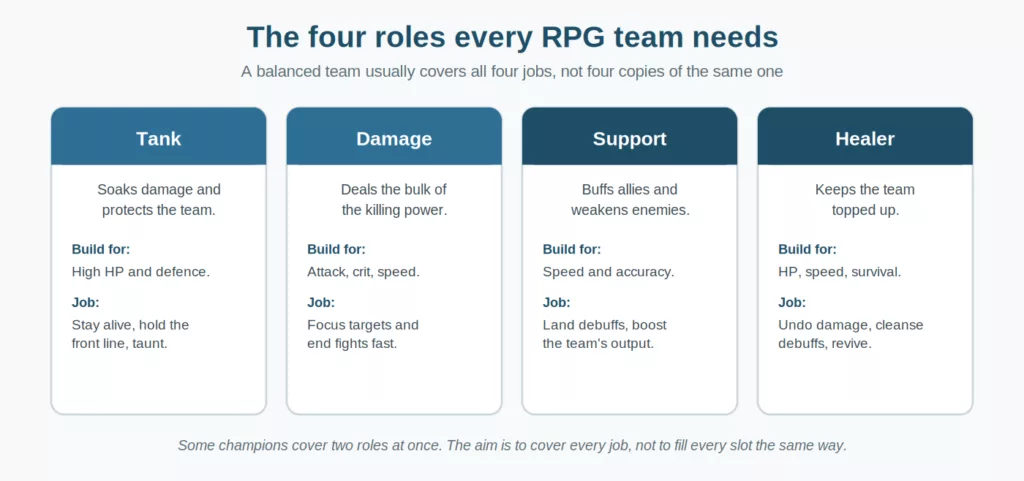
Cover every job. A team that can take a hit, deal damage, buff and heal beats four glass cannons.
Synergy is the real multiplier
The strongest teams are built around synergy, where characters amplify each other. A support that boosts the team’s attack makes every damage dealer hit harder. A character that strips an enemy’s defence multiplies the damage of everyone attacking after it. When you choose a team, do not just ask whether each character is good on its own, ask what each one does for the others. This is where the real depth of RPG strategy lives, and it is what experienced players are thinking about when they pick a lineup.
Turn order and target priority
In turn-based RPGs, the order in which characters act is often more important than raw power. Acting first lets you land debuffs before the enemy moves, apply shields before the big hit comes, or simply kill a threat before it gets a turn, which is why speed is so prized. Alongside turn order, target priority matters: focus fire to remove one enemy entirely rather than spreading damage across several, since a dead enemy deals no damage while a wounded one still does.
Use counters and matchups
Many RPGs have a counter system, such as elemental types or affinities where one beats another in a rock-paper-scissors fashion. Bringing the right counter to a fight can swing it dramatically, turning a hard battle into a comfortable one. Before a tough encounter, check what you are up against and adjust your team to counter it, rather than bringing the same lineup to everything.
Putting it together: a worked example
To see all three pillars in one place, it helps to look at a game built around exactly this kind of optimisation. RAID: Shadow Legends is a turn-based collection RPG where build, gear and strategy are the whole game, which makes it a clear illustration of the framework.
On the build side, every champion has a role (attack, defence, support, healer) and an affinity, and the first job is to identify what each one is for and invest accordingly. A debuffer needs accuracy to make its debuffs land; a nuker needs crit rate and crit damage to hit hard. On the gear side, champions equip artifact sets: a speed set to act sooner, a set that ignores enemy defence for damage dealers, a healing set for supports. The discipline of upgrading gear in stages and only committing to good substat rolls applies directly. And on the strategy side, champions have four affinities in a rock-paper-scissors relationship, so bringing the right affinity to a battle is a concrete counter, while team-building is about combining a tank, damage, a debuffer and a healer who amplify each other.
None of that is unique to one game. The same loop, work out the role, build the stats, choose gear that serves the role, then field a balanced and synergised team, is what improving at almost any RPG comes down to. A game with all three layers visible just makes the framework easy to see in action.
If you want a game to practise the framework on, RAID: Shadow Legends is free to play, or you can browse other RPG games to find one that suits your style.
A repeatable routine for improving any character
When you want to upgrade a specific character or fix one that underperforms, work through these steps in order rather than tinkering at random. This is the same loop theorycrafters use, simplified.
- Define the job. Decide exactly what this character is for: main damage, tank, debuffer, healer. Everything else follows from this.
- Set the stat priorities. List the two or three stats that matter most for that job, and the ones you can ignore.
- Pick the set. Choose the gear set whose bonus best serves the job before worrying about individual pieces.
- Gear for the priorities. Equip pieces that push your key stats, favouring percentages and good substats over raw rarity.
- Test on a stable target. Run a repeatable fight and note how it performs: damage per turn, survival time, whether debuffs land.
- Change one thing at a time. Swap a single piece or skill, then re-test. If you change three things at once, you will not know which helped.
- Lock in breakpoints, then move on. Once you hit a key threshold, stop stacking that stat and push the next one that now gives more.
| The habit that matters mostImprovement is iterative, not one big perfect build. The players who get good are the ones who test, tweak one variable, and re-test, patiently. The framework points you in the right direction; the testing loop is what gets you there. |
Common mistakes that keep players stuck
- Spreading investment evenly. Trying to be good at everything leaves a character good at nothing. Focus.
- Chasing rarity over fit. A legendary piece with the wrong stats is worse than a common one with the right ones.
- Ignoring speed. In turn-based games, acting first is often worth more than hitting harder.
- Fielding five damage dealers. A team with no survivability or support collapses against anything tough.
- Over-upgrading mediocre gear. Pouring resources into a bad piece because it is already half done is a sunk-cost trap.
- Bringing the same team to everything. Adjusting for counters and matchups turns hard fights into easy ones.
Frequently asked questions
What is the fastest way to get better at RPGs?
Learn your game’s soft caps and breakpoints, then build with intent rather than spreading resources evenly. Knowing exactly when to stop stacking one stat and switch to another is the single highest-impact habit, because it stops you wasting the resources that everyone has in limited supply.
What does ‘build’ mean in an RPG?
A build is the specific combination of stats, skills and gear that defines what a character is good at. A damage build maximises attack, crit and speed; a tank build maximises health and defence. Improving at RPGs is largely about making deliberate build choices that suit each character’s role instead of investing at random.
Is gear or strategy more important?
Both matter, and they work together. Gear and build make individual characters strong, but strategy, especially team composition and synergy, is what converts strong characters into wins. A perfectly geared team with no balance or synergy will still lose to a smartly built one. Aim to improve all three pillars rather than relying on any single one.
How do I build a good RPG team?
Cover every role: someone to absorb damage, someone to deal it, someone to support with buffs and debuffs, and someone to heal. Then look for synergy, where characters amplify each other, such as a support that boosts your damage dealer’s attack. A balanced, synergised team beats a team of your strongest characters thrown together.
Why is speed so important in turn-based RPGs?
Speed determines turn order, and acting first lets you land debuffs, apply shields or remove a threat before the enemy can move. In many turn-based games, having enough speed to take an extra turn is worth more than a large boost to damage, which is why experienced players prize it so highly and build around speed breakpoints.
What stats should I prioritise on gear?
It depends on the role. Damage dealers want crit rate, crit damage, attack and speed; tanks want health and defence; supports want speed and accuracy; healers want speed and survivability. As a universal rule, favour percentage stats over flat ones, and pay attention to the smaller substats, which often decide whether a piece is great or merely average.
The bottom line
Getting better at RPGs is not about luck or grinding endlessly. It comes down to three skills you can deliberately develop: building characters with intent, gearing them to serve their role, and playing them as a coordinated team. Master the maths of stats, the logic of set bonuses, and the art of synergy, and you will improve faster than any amount of aimless grinding could deliver.
Start with one character. Define its job, set its stat priorities, gear it for those priorities, then test and tweak one thing at a time. Do that consistently and the habit spreads across your whole roster. The best way to learn it is to apply it, so pick a game with real build, gear and strategy depth and start theorycrafting.
Want somewhere to put the framework into practice? Browse free RPG games, and if you play on PC, you can run them through Plarium Play, the free official launcher.