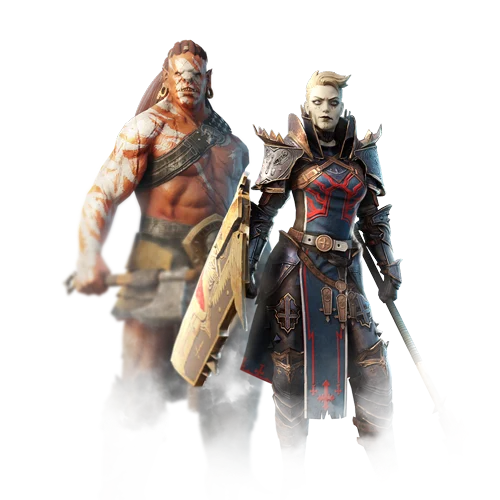
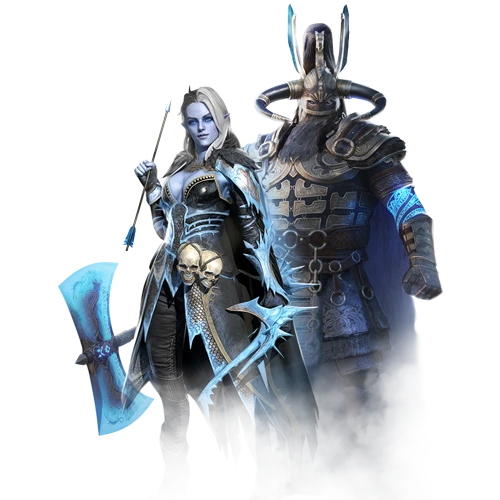
What Is a Champion in Games? Gaming Term Explained


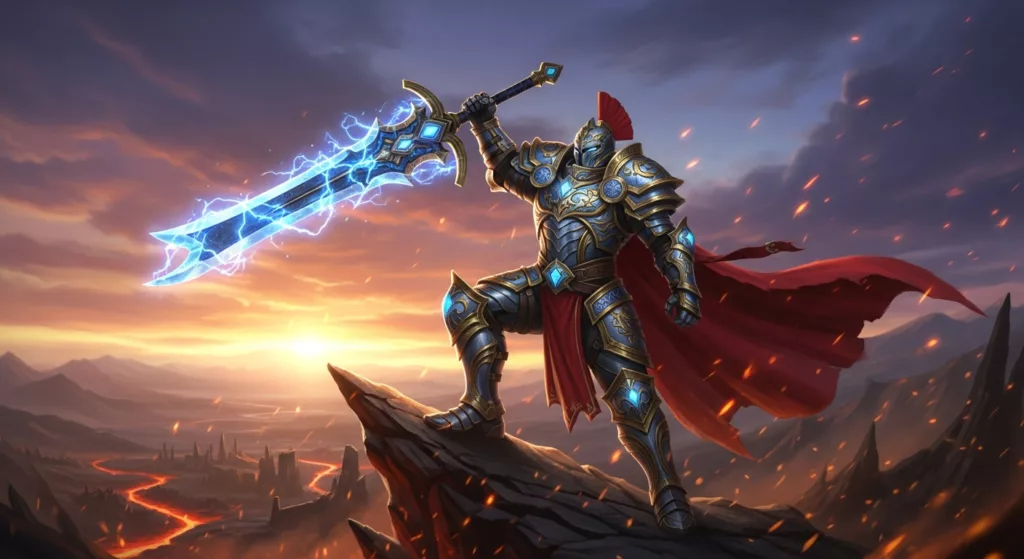
A champion is whatever the game makes its star: the hero you pilot, or the heroes you collect.
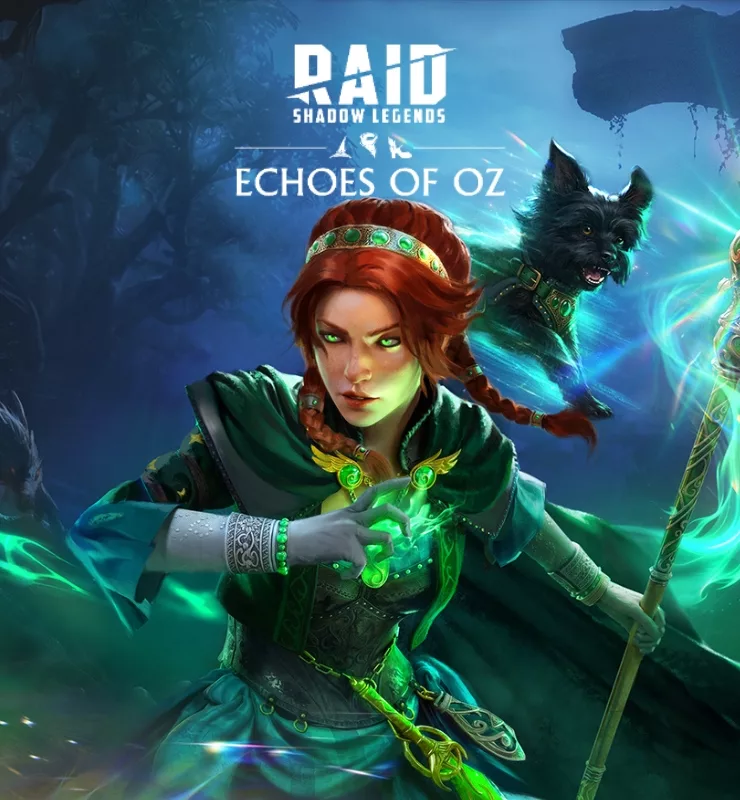


What the word means, why it shows up in so many games, and how it differs from a hero or a character.
In games, a champion is a powerful, named character with its own abilities, role and identity. The word is used in two main ways: in MOBAs and arena games it means the single character you control during a match, and in collection RPGs it means one of many characters you recruit, level up and assemble into teams. In both cases, a champion is more than a generic avatar. It is a distinct unit you choose, build and master.
If you have played almost any modern multiplayer or role-playing game, you have used a champion, even if the game called it something else. This guide explains what the term means, the two ways games use it, how a champion differs from a hero or a character, and what actually defines one.
The two main meanings of ‘champion’
The confusing thing about the word is that two very different types of game both use it, and they mean slightly different things by it. Understanding which kind of game you are in clears up most of the confusion.
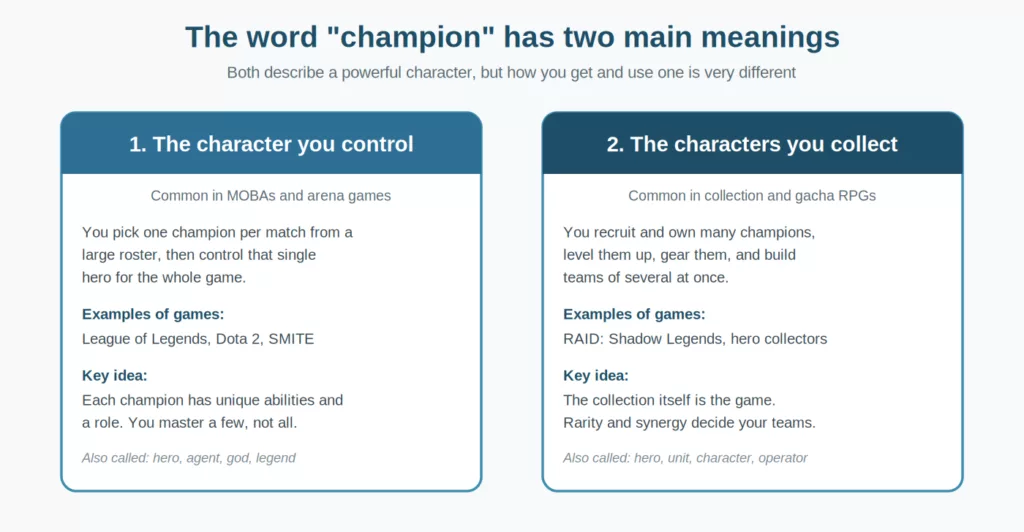
The same word, two different jobs: the one you pilot versus the many you own.
1. The single character you control (MOBAs)
This is the meaning most associated with the word, and it comes from the MOBA genre: games like League of Legends, Dota 2 and SMITE. In these games you pick one champion at the start of a match from a large roster, and you control that single character for the whole game. Each champion has a unique set of abilities, a defined role, and a distinct playstyle. League of Legends in particular is what cemented the word champion in gaming vocabulary, which is why so many players associate the term with the genre.
In this sense, the skill of the game is partly about mastering individual champions. Most players learn a handful of favourites deeply rather than trying to be good with all of them, because each one plays so differently from the next.
2. The many characters you collect (RPGs)
The second meaning comes from collection RPGs, sometimes called hero collectors or gacha games. Here, champions are the characters you recruit and own, often hundreds of them, and the game is built around collecting, upgrading and combining them. Instead of controlling one champion, you assemble a team of several and send them into battle together.
In this kind of game the collection itself is the point. You acquire new champions, level them up, equip them with gear, and work out which combinations are strongest. RAID: Shadow Legends is a well-known example, with a roster of well over 900 champions to collect and build teams from. The strategy lies not in piloting one character perfectly, but in building the right squad.
Champion vs hero vs character: what’s the difference?
These three words are often used interchangeably, and in many games they mean exactly the same thing. The differences are conventions rather than strict rules, and they vary from game to game.
| Term | What it usually means | Where you’ll hear it |
|---|---|---|
| Champion | A powerful, distinct unit you pick or collect | MOBAs, collection RPGs |
| Hero | Almost identical to champion, slightly broader | MOBAs, RPGs, strategy games |
| Character | The most general word for any playable figure | Almost every genre |
| Unit | A controllable piece, often one of many | Strategy games, RPGs |
In practice, champion and hero are near-synonyms. Many games use one or the other purely for flavour: a fantasy game might prefer champion or hero, while a sci-fi shooter might say agent or operator for the same idea. Character is the catch-all term that covers all of them. So if you see champion, hero and character used loosely in the same conversation, that is normal, and you can usually treat them as the same thing unless a specific game defines them differently.
A rule of thumb: champion implies the character is a notable, build-worthy unit you specifically choose or collect, rather than a faceless soldier or a background non-player character.
What defines a champion?
Whatever the game and whatever it calls them, champions tend to be built from the same set of ingredients. These are the things that make a champion feel like a champion rather than a generic unit.
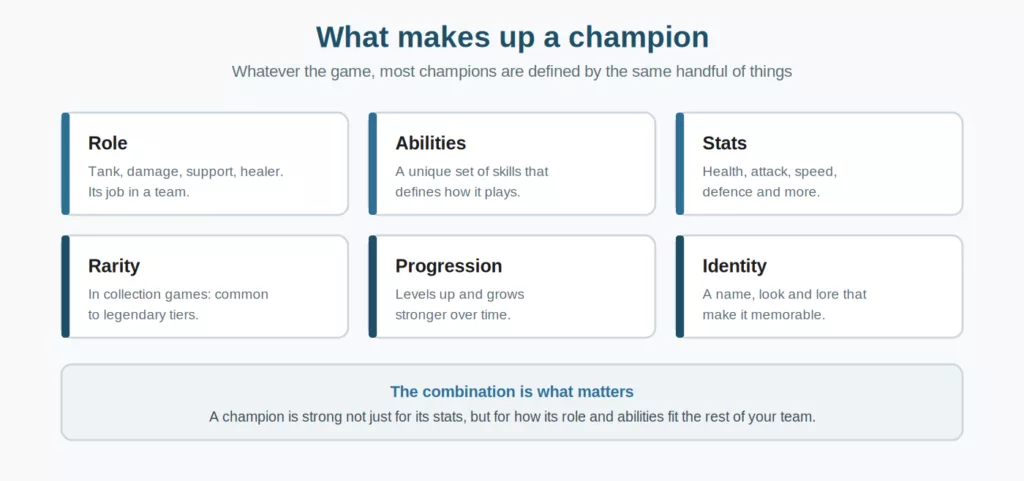
Most champions are defined by some combination of these traits.
Role
A champion almost always has a job in a team. The common roles are the tank that absorbs damage, the damage dealer that does the killing, the support that buffs allies, and the healer that keeps everyone alive. Knowing a champion’s role tells you how to use it and who it works well alongside.
Abilities
The thing that separates one champion from another is its unique set of abilities or skills. These define how it plays: one champion might fling area-of-effect spells, another might land single-target assassinations, another might shield its allies. A champion’s abilities are its personality in gameplay terms.
Stats
Underneath the abilities sit the numbers: health, attack, defence, speed and so on. Stats determine how durable and how powerful a champion is, and in many games you improve them as the champion levels up or as you equip better gear.
Rarity (in collection games)
In collection RPGs, champions usually come in rarity tiers, running from common up to epic, legendary and beyond. Rarer champions are harder to obtain and often more powerful or more specialised. In RAID: Shadow Legends, for example, champions span several rarity tiers and four affinities that interact in a rock-paper-scissors system, which adds a layer of strategy to team-building on top of the raw stats.
Identity
Finally, a champion has a name, a look and usually a backstory. This is what makes players form attachments and remember their favourites. A champion you have built and won battles with stops being a stat block and becomes your champion.
How champions work in a real game
The clearest way to understand the collection-RPG version of a champion is to look at a game built entirely around the idea.
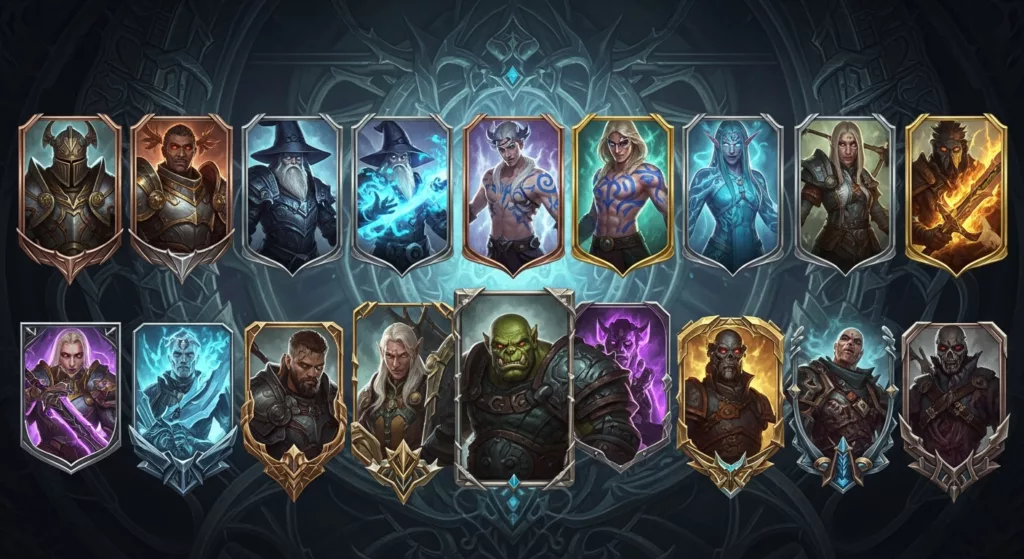
In a collection RPG, your roster of champions is the heart of the game.
RAID: Shadow Legends is a turn-based collection RPG where champions are the entire foundation of play. You recruit them, often by summoning from in-game shards, and each one arrives with a fixed rarity, faction, affinity and role. From there the game is about growing your collection and building teams: a tank to soak damage, an attacker to deal it, a support to apply buffs and debuffs, all working together.
What makes it a good illustration of the term is that no single champion wins on its own. A powerful legendary champion still needs the right teammates around it, and a humble rare champion can be essential for a specific battle thanks to one well-timed ability. That is the heart of what a champion is in a collection game: a piece whose value depends on how it fits the whole. With a roster in the hundreds, the depth comes from the combinations, not from any one card.
This is far from the only game built this way. The same idea drives hero collectors across mobile and PC, where assembling and upgrading a roster of distinct characters is the core loop. If you want to see how it works first-hand, it is free to try.
You can explore RAID: Shadow Legends, or browse more RPG games to see how different titles handle their champions.
Why games use the word ‘champion’ at all
Calling a character a champion does real work. It signals that this is a figure worth investing in, not a disposable unit. It carries a sense of prestige and individuality that words like unit or soldier do not, which suits games where you are meant to form a bond with the characters you pick or collect.
It also helps with clarity. In a game with hundreds of characters, having a clear category word, champion, for the build-worthy, collectible, controllable ones makes it easier to talk about strategy. When a guide says build this champion, you know exactly what kind of thing it means. The word has become a small piece of shared gaming vocabulary precisely because it is useful.
Frequently asked questions
What does champion mean in games?
A champion is a powerful, named character with its own abilities, role and identity. In MOBAs it refers to the single character you control during a match, while in collection RPGs it refers to the many characters you recruit and build teams from. In both cases it describes a distinct, build-worthy unit rather than a generic figure.
Is a champion the same as a hero?
In most games, yes. Champion and hero are near-synonyms, and many games use one or the other purely for flavour. Some games do draw a distinction, but as a general rule you can treat them as the same thing: a powerful, distinct character you choose or collect. Always check how a specific game uses the words if it matters.
Why does League of Legends call characters champions?
League of Legends uses champion as its term for the playable characters you pick at the start of each match. The game’s huge popularity is a big part of why the word champion became so strongly associated with the MOBA genre and with gaming in general. Other MOBAs use hero or god for the same concept.
What is a champion in an RPG?
In a collection RPG or hero collector, a champion is one of the many characters you recruit, level up and combine into teams. The game is built around acquiring and upgrading them. Each champion typically has a rarity, a role and a unique set of abilities, and the strategy lies in building the strongest team from your collection.
What makes a champion powerful?
It is rarely just raw stats. A champion’s power comes from the combination of its role, its abilities, its stats and, in collection games, its rarity, plus how well it fits the rest of your team. A champion with a perfectly timed support ability can be more valuable than a high-damage one if it is what your team needs.
Can you have more than one champion?
It depends on the type of game. In MOBAs you control one champion per match, though you own access to many and switch between them game to game. In collection RPGs you own a whole roster and field several champions at once as a team. The word fits both single-character and many-character games.
The bottom line
A champion is a game’s way of saying this character matters. Whether it is the single hero you pilot through a MOBA match or one of hundreds you collect in an RPG, a champion is a distinct unit with its own abilities, role and identity that you choose, build and master. The word is close in meaning to hero and character, and games use whichever fits their style.
If you want to understand the collection-RPG sense of the word properly, the best way is to build a team yourself and feel how each champion’s role and abilities click together. That moment, when a roster of separate characters becomes a team that wins, is exactly what the word is pointing at.