Best Card Games to Play by Yourself in 2026: Solo Card Games


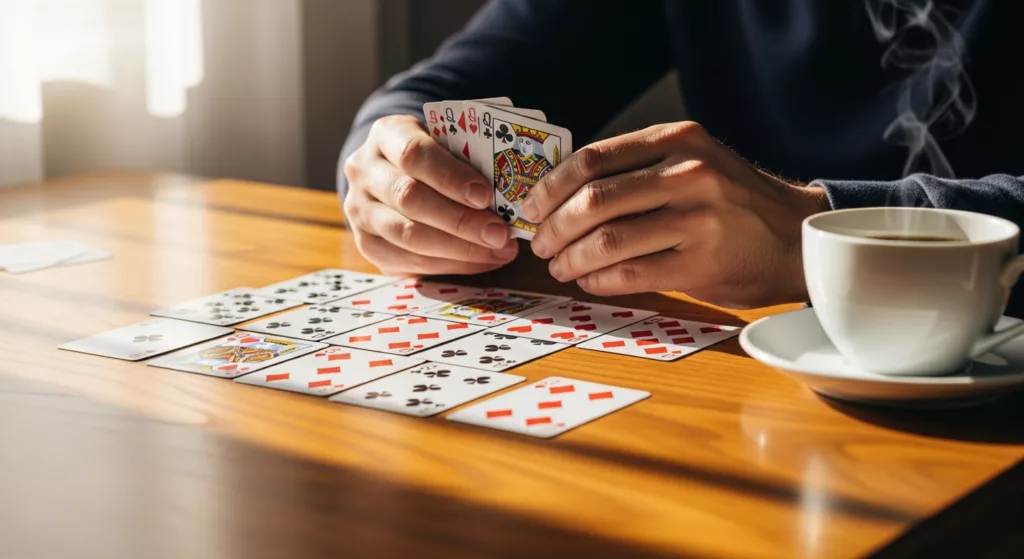
From the classics you can play with a real deck to the best card apps for killing time on your own.



Card games are the original solo entertainment. Long before phones, a single deck and a flat surface could fill an afternoon, and that has not really changed. What has changed is the sheer range of ways you can now play alone, from a physical pack of cards on the kitchen table to deck-building roguelikes that have quietly become some of the most acclaimed games of the past decade.
We put this list together by playing the lot, both the analogue classics with an actual deck and the digital ones across mobile and PC. Some we have played for years. Some we picked up specifically to test for this piece. The aim was simple: which card games are actually worth your time when it is just you?
We have split them into three groups, because “solo card game” covers wildly different things. There are the classics you can play right now with a deck you already own, the polished card apps built for playing on your phone, and the modern video games that took the humble deck of cards and turned it into something deeper. Whatever mood you are in, there is something here.
The quick-pick summary
The full list at a glance. Each verdict is the short version of the review further down.
| Game | Type | Format | Price | One-line verdict |
|---|---|---|---|---|
| Undersea: Solitaire Tripeaks | Solitaire app | Mobile, Browser | Free | The most relaxing solitaire app, with a town to build alongside it. |
| Klondike (Classic Solitaire) | Classic | Real deck, any device | Free | The solitaire everyone means when they say solitaire. |
| Spider Solitaire | Classic | Real deck, any device | Free | The thinking person’s solitaire, scalable from easy to brutal. |
| FreeCell | Classic | Real deck, any device | Free | Almost every deal is winnable, so losses are on you. |
| Pyramid | Classic | Real deck, any device | Free | Quick, additive, and ruthless about the luck of the deal. |
| Slay the Spire | Deck-builder | PC, Console, Mobile | £19 | The game that made deck-building roguelikes mainstream. |
| Balatro | Deck-builder | Everything | £14 | Poker hands meet roguelike, and it is dangerously moreish. |
| Solitaire Grand Harvest | Solitaire app | Mobile | Free | TriPeaks with a farm to tend, big and polished. |
| Inscryption | Card adventure | PC, Console | £16 | A card game wrapped in a horror mystery, best played blind. |
| Card Crawl | Card puzzle | Mobile | £3 | A dungeon crawl built from a single deck, perfect in short bursts. |
The classics you can play with a real deck
These cost nothing, need no download, and have entertained people for generations. If you have a pack of cards in a drawer, you can play every one of these tonight. They are also the games most of the apps below are built on top of, so they are worth knowing in their pure form.
1. Klondike, the solitaire everyone means by ‘solitaire’
Verdict: The default solo card game for good reason, simple to learn and endlessly familiar, though only a fraction of deals are actually winnable.
Who it’s best for: Anyone who wants the comfort of a game they already half-know, with no rules to look up.
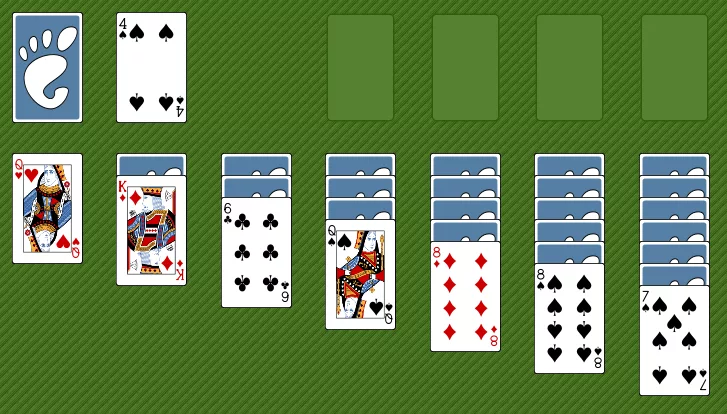
When someone says they are playing solitaire, this is almost always the game they mean. Build four suit piles up from ace to king, work through the stock, and shuffle cards between the seven tableau columns to free up what you need. It is the one that shipped with every old Windows machine and taught a generation how to drag and drop.
Its strength is pure familiarity. There is no learning curve and no fuss, which is exactly why it endures. Played with a real deck, the act of laying out the seven columns is itself a small ritual that signals it is time to slow down for a few minutes.
The honest downside: A lot comes down to the deal. Depending on the draw rules, a meaningful share of games are simply not winnable, and there is nothing you can do about it. That randomness is relaxing for some and maddening for others.
2. Spider Solitaire, the thinking person’s solitaire
Verdict: More demanding than Klondike and far more satisfying when it clicks, with a difficulty you can dial up as you improve.
Who it’s best for: Players who find Klondike too reliant on luck and want a solitaire where skill clearly matters.
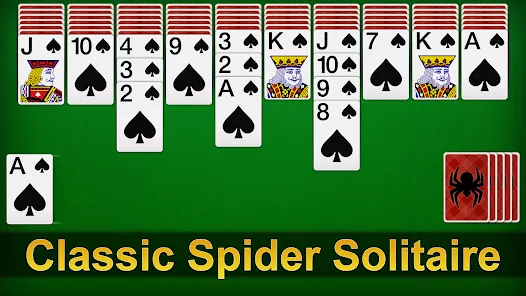
Spider uses two decks and asks you to build descending sequences within suits, then clear them once a full king-to-ace run is complete. The clever part is the difficulty scaling: one suit is gentle, two suits is a proper challenge, and four suits is properly hard. That built-in progression keeps it interesting long after Klondike has gone stale.
Because you can almost always make some move, it feels less arbitrary than Klondike. The better you plan your sequences and manage your empty columns, the more often you win. It rewards thinking ahead, which makes a winning game feel earned rather than lucky.
The honest downside: The two-deck layout is large and a little awkward to manage with physical cards on a small table, so this is one of the classics that simply plays better on a screen.
3. FreeCell, the one where losses are your fault
Verdict: The most skill-based of the traditional solitaires, since almost every deal can be won with the right play.
Who it’s best for: Players who want a solitaire that is effectively a solvable puzzle, where the only thing standing between you and a win is your own planning.
FreeCell deals every card face up from the start and gives you four free cells to temporarily park cards. Because you can see everything and nothing is hidden, it becomes a puzzle of sequencing rather than a gamble. The famous fact about FreeCell is that the overwhelming majority of deals are winnable, which flips the psychology of solitaire entirely.
That changes how it feels to lose. In Klondike a loss can be the deal’s fault; in FreeCell it is almost always yours, which sounds harsh but is actually the appeal. Every game is a fair fight, and getting better is visible and rewarding.
The honest downside: All that information on display makes it more mentally taxing than the others. It is less of a wind-down game and more of a deliberate puzzle, so it suits a focused mood rather than a tired one.
4. Pyramid, quick, additive and a little cruel
Verdict: A fast, light solitaire about pairing cards to thirteen, ideal for a five-minute break, though heavily dependent on the deal.
Who it’s best for: Players who want a quick, low-commitment classic that fits into the gaps in a day.
Pyramid lays out 28 cards in a pyramid shape and asks you to remove pairs that add up to thirteen, clearing your way down to the top card. It is quick to set up, quick to play, and quick to win or lose, which makes it the classic to reach for when you only have a few minutes.
There is just enough decision-making in which pairs to clear first to keep it engaging, but it never demands the concentration FreeCell does. It is the card-game equivalent of a quick crossword.
The honest downside: Of all the classics, Pyramid leans hardest on luck. Plenty of deals are unwinnable from the start, so it works best as a casual time-filler rather than a game you take seriously.
The best solo card apps for your phone
If you want the classics without shuffling, or something purpose-built for playing on a phone, these are the apps worth your screen time. The best of them wrap the familiar card play in a little progression so there is always a reason to play one more hand.
5. Undersea: Solitaire Tripeaks, the most relaxing solitaire app
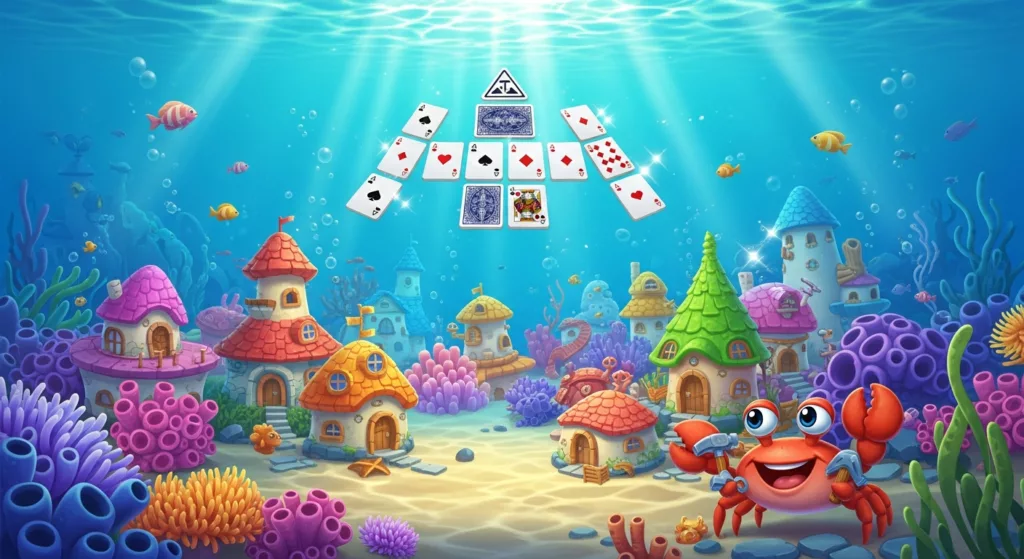
Undersea pairs classic TriPeaks solitaire with a cheerful town-building layer set on the seabed.
Verdict: A TriPeaks solitaire game with a cosy town-builder bolted on, and one of the most relaxing solo card apps going.
Who it’s best for: Players who find pure solitaire a bit dry and want a gentle goal to play toward, in short sessions on a phone.
TriPeaks is the solitaire variant where you clear three peaks of cards by selecting any card one rank above or below the one in your hand. It is fast, satisfying and forgiving, and Undersea builds the whole experience around it. As you clear levels you earn resources to rebuild a charming undersea town of Rocky Bottom, helping Alfred the Crab restore the place one building at a time.
That second layer is what sets it apart from a plain solitaire app. The card play gives you the moment-to-moment satisfaction, and the town gives you a longer-term reason to keep going. We found it well suited to short bursts: clear a few levels, decorate a corner of the town, put the phone down. It comes from the same studio behind RAID: Shadow Legends, and the polish shows in how smoothly it all hangs together.
The honest downside: Like most free solitaire apps, it uses a lives system, so a run of tricky levels can leave you waiting for lives to refill or nudged toward a purchase. If you want unlimited, uninterrupted play, that model will occasionally get in your way. It is best enjoyed at a relaxed pace rather than rushed.
How it compares: Against Solitaire Grand Harvest, the other big solitaire-plus-builder app, it comes down to theme and feel. Both pair TriPeaks with a progression layer; Undersea leans into a tighter, charm-led undersea story, while Grand Harvest is larger and farm-themed. If you want something cosy and characterful, Undersea is the easier game to love.
Price: Free to play, with optional purchases for coins and lives.
Available on mobile and browser. See the Undersea: Solitaire Tripeaks page, or browse more free games.
6. Solitaire Grand Harvest, TriPeaks with a farm to tend
Verdict: A big, polished TriPeaks app with a farming meta-layer, deep on content but more aggressive with its monetisation.
Who it’s best for: Players who want a large, content-rich solitaire app they can play for months and do not mind a free-to-play structure.
Grand Harvest is one of the most popular solitaire apps on the market, and the core is the same forgiving TriPeaks play as Undersea. The difference is scale and theme. There is a vast number of levels, a farm-building progression, and a steady drip of events and rewards designed to keep you logging in.
As a pure solitaire experience it is excellent, and the farming layer gives the same kind of long-term goal. If you want the most content in this style, it has it in abundance.
The honest downside: The monetisation is noticeably more present than in some rivals, with frequent prompts and events built around spending coins. Plenty of players enjoy it entirely for free, but you will need to ignore a fair amount of nudging to do so.
7. Card Crawl, a dungeon built from one deck
Verdict: A clever solo card puzzle that turns a single deck into a dungeon crawl, perfect for short, thoughtful sessions.
Who it’s best for: Players who want something smarter than solitaire but smaller than a full deck-builder, in bite-sized chunks.
Card Crawl is a small, elegant solo game where a deck represents a dungeon. Cards are monsters, weapons, potions and shields, and you play them from a four-slot board, fighting through the deck while managing your health. It sounds simple and is easy to pick up, but there is real strategy in the order you resolve cards.
It is the kind of game built for a bus journey or a coffee break. A run takes a few minutes, the rules fit on a single screen, and yet there is enough depth in chasing a high score to keep pulling you back. For the price of a coffee it offers a remarkable amount of replayability.
The honest downside: Its scope is deliberately small. If you want a sprawling progression system or hours of content per session, this is not that. It is a perfectly formed snack, not a meal.
Modern card games that go deeper
Over the past decade, designers have taken the basic idea of a deck of cards and built some of the most acclaimed solo games around. These are full video games rather than digital versions of the classics, and they are where solo card play gets seriously deep.
8. Slay the Spire, the deck-builder that started it all
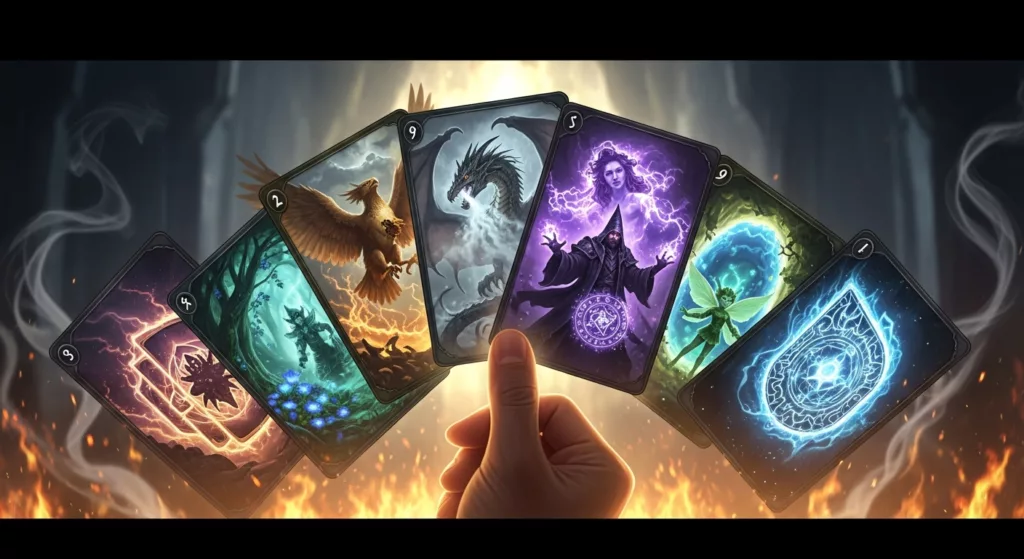
Deck-building roguelikes turn the hand you draw into a strategic puzzle that changes every run.
Verdict: The game that made the deck-building roguelike a mainstream genre, and still one of the best solo card games ever made.
Who it’s best for: Players who want real strategic depth and do not mind a learning curve, in runs of roughly thirty minutes to an hour.
Slay the Spire combines a roguelike structure with deck-building. You climb a tower, fighting enemies card by card, and after each battle you add new cards to your deck. The skill is in building a coherent strategy from the cards you are offered, knowing when to add a card and, crucially, when to skip one to keep your deck lean.
It is a solo game to its core. Every run is a fresh puzzle, the synergies between cards run deep, and the difficulty modifiers give you a near-endless ladder to climb once you have mastered the basics. It is the game that launched a hundred imitators, and it still holds up against all of them.
The honest downside: The learning curve is real. Your first few runs will end quickly and you may not fully understand why, and the breadth of card interactions can overwhelm newcomers before it clicks.
9. Balatro, poker hands turned into something dangerous
Verdict: A roguelike built on poker hands that is almost impossible to put down once it gets going.
Who it’s best for: Players who want the moreish ‘one more run’ loop of a deck-builder with a lower barrier to entry than Slay the Spire.
Balatro takes the familiar idea of poker hands, pairs, flushes, straights, and turns it into a roguelike scoring engine. You play hands to hit a target score, then spend your winnings on joker cards that bend the rules in increasingly absurd ways. The joy is in discovering combinations that send your score spiralling into the millions.
Because everyone already understands poker hands, it is far easier to get into than most deck-builders, yet the strategic ceiling is enormous. It became a phenomenon for a reason. We lost more evenings to it than we are comfortable admitting.
The honest downside: It is so compelling that it eats time in alarming quantities, and the late-game maths can get fiddly to track in your head once the jokers stack up. The minimalist presentation also will not grab everyone.
10. Inscryption, a card game wrapped in a mystery
Verdict: Part deck-builder, part escape-room horror, and best experienced knowing as little as possible going in.
Who it’s best for: Players who want a solo card game with a story and atmosphere, and who enjoy being surprised.
Inscryption starts as a dark, atmospheric card game played across a table from a mysterious opponent, then becomes something much stranger and harder to describe without spoiling it. The card battling itself is sharp and inventive, but the reason it is on this list is that it uses the card game as the vehicle for one of the most surprising solo experiences in years.
It is a game best played alone, in the dark, knowing nothing. The less you read about it beforehand, the better. That is rare for a card game and worth protecting.
The honest downside: The experience is uneven by design, and not every phase lands equally well for every player. Some adore the shifts in direction; others wish it had stuck with its strongest section for longer.
Matching the game to your mood
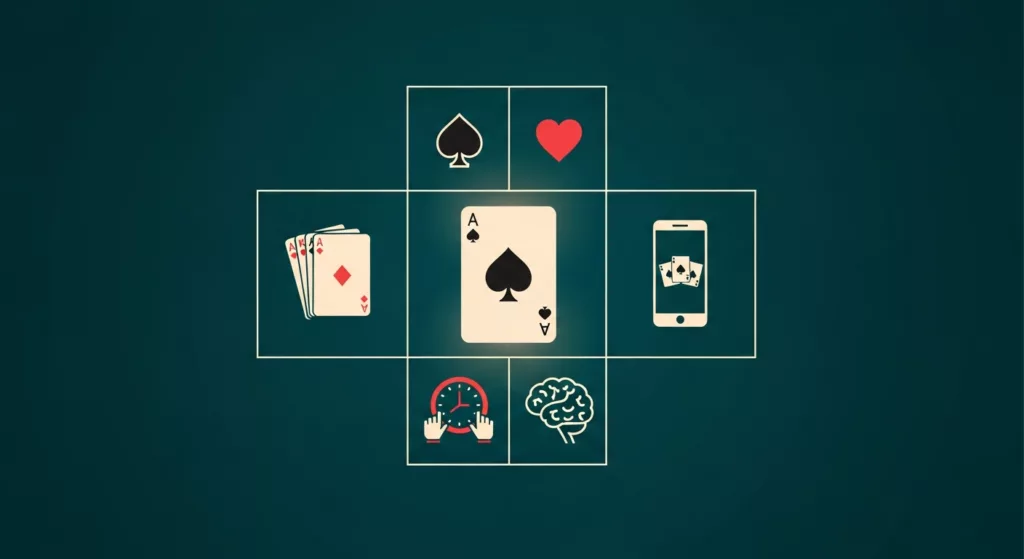
The right solo card game depends entirely on how much time and brainpower you want to spend.
There is no single best solo card game, only the right one for the moment. Here is the shortcut we use.
- You have a real deck and five minutes: Pyramid or Klondike.
- You want a solitaire that rewards skill: FreeCell or Spider Solitaire.
- You want something cosy and relaxing on your phone: Undersea: Solitaire Tripeaks or Solitaire Grand Harvest.
- You want a quick, clever puzzle on the go: Card Crawl.
- You want real strategic depth: Slay the Spire or Balatro.
- You want a card game with a story: Inscryption.
Honourable mentions
A few more worth knowing. Monster Train is an excellent deck-builder in the Slay the Spire mould with a clever two-lane twist, if you finish the Spire and want more. Solitaire (the plain built-in version on your phone or computer) deserves a mention for sheer accessibility, since it is already installed on most devices. And Hearthstone has a solid solo adventure mode buried inside it, though the game as a whole is built around online play, which kept it off the main list.
How we chose these games
We started with a longlist of more than 25 card games, weighing the timeless classics against the newer digital titles. We cut anything that only really works with other players, the multiplayer-first games like most online poker, and anything where the solo mode felt bolted on. We also leaned toward games that are either free or cheap, since card games should be accessible by nature.
Each pick was judged on four things: how well it suits playing alone, how easy it is to learn versus how much depth it eventually offers, how well it fits around real life in short or long sessions, and whether it gives you a reason to keep coming back. The classics were played with a physical deck where possible, and the digital games were played on the platforms most people will use them on.
One note on transparency: one of our picks, Undersea: Solitaire Tripeaks, is made by Plarium, which publishes this blog. We have reviewed it with the same honesty as everything else, downsides included. It earns its place because it is a properly relaxing solo solitaire game, and it would not be here otherwise.
The bottom line
The best thing about solo card games is the range. You can reach for a physical deck and play a game that has existed for a century, open a cosy app for ten relaxed minutes, or sink an evening into a strategy game that happens to use cards. None of them needs another person, and that is the point.
If you want a starting point: grab a real deck and learn FreeCell for a fair, skill-based classic, download Undersea: Solitaire Tripeaks if you want something relaxing on your phone, and try Balatro the moment you have a free evening and want to understand why everyone keeps talking about it.
If you would rather start with something free you can play right now, browse free games to play alone and find your next one.