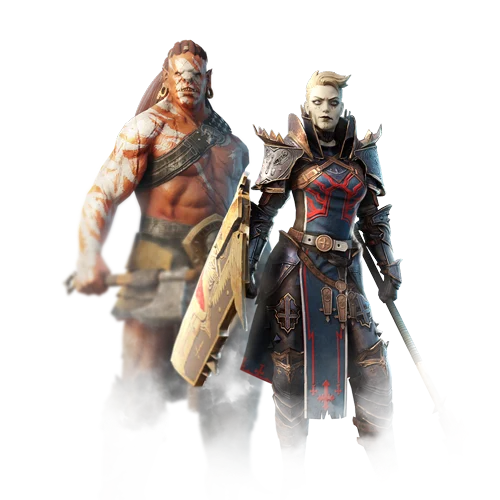
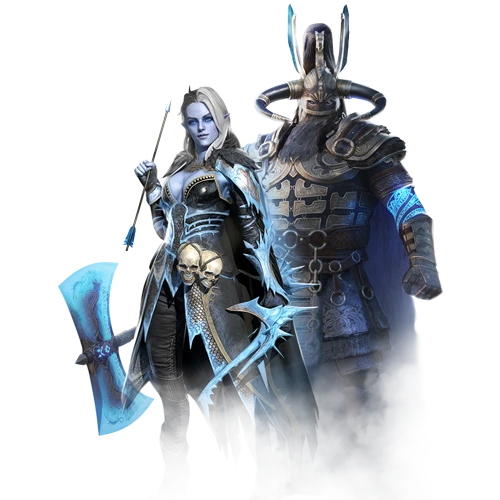
What Is a Clan in Games? Clans, Guilds and Alliances Explained

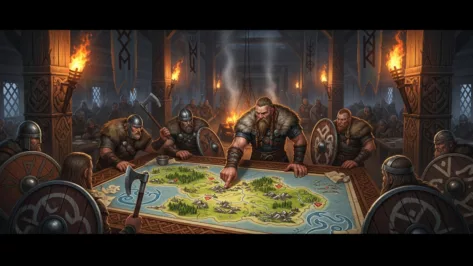
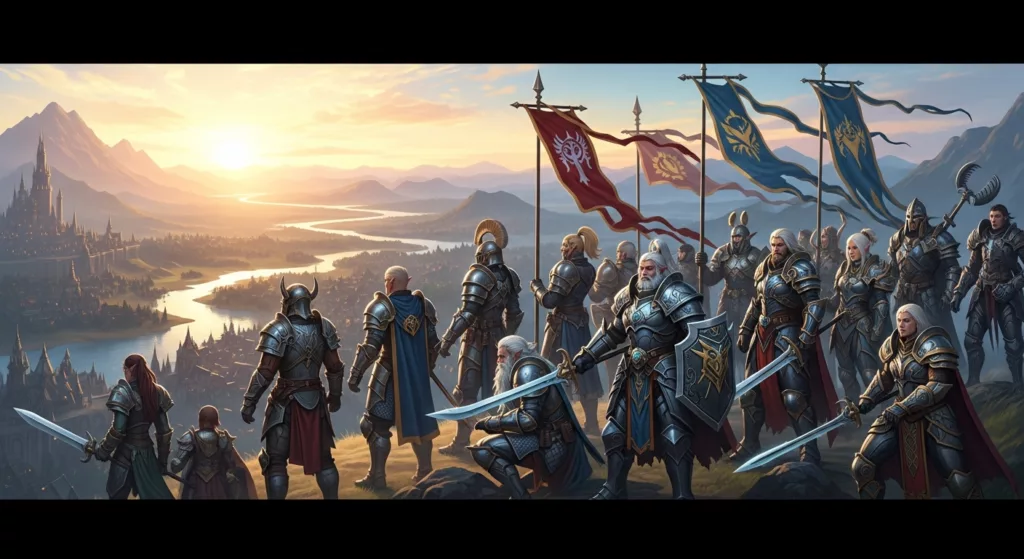
Whatever the game calls them, these groups are how strangers become teammates.


A plain-English guide to the player groups that hold multiplayer games together, and what the different names actually mean.
A clan is a named, organised group of players who team up to play a game together over the long term. Members share a tag or banner, follow a leader and a set of ranks, pool resources, and work toward common goals like winning wars, completing raids or climbing the rankings. The same idea goes by different names depending on the game: clan, guild, alliance, faction, and a few stranger ones besides.
If you have ever opened a multiplayer game and been asked whether you want to join a clan, you have met the single most important social feature in online gaming. These groups are what turn a game you play next to other people into a game you play with them. This guide explains what each term means, how the groups are structured, why they matter, and how to find a good one.
Clan, guild, alliance: are they the same thing?
Mostly, yes. In everyday use these words are interchangeable, and most players treat them as synonyms for the same basic thing: a persistent group of players. The differences are softer conventions than hard rules, and they come partly from each word’s real-world history and partly from which genre adopted it first.
Clan
Clan caught on in competitive games, especially the early first-person shooters, where small, tight teams formed to compete against each other. The word carries a slightly more combative, tribal feel, which is why competitive and strategy games tend to use it. A clan often implies a group built around winning.
Guild
Guild comes from the medieval trade associations of craftsmen and merchants, and it was adopted by fantasy role-playing games and MMORPGs like World of Warcraft. It carries a more cooperative, community feel: players band together to take on big cooperative challenges such as raids, to level up together, and to socialise. A guild often implies a group built around playing together rather than purely winning.
Alliance
Alliance is most common in strategy and empire-building games, and it usually sits one level higher than a clan or guild. An alliance is often a group of clans, or a large group in its own right, formed to control territory and wage large-scale war. The word fits the diplomatic, map-conquering nature of the strategy genre.
Faction and other names
Plenty of games invent their own term, or use one of these words in their own particular way. EVE Online famously calls its groups corporations, and stacks them into alliances and then coalitions. Final Fantasy calls them linkshells. City of Heroes used supergroups. A faction usually refers to a very large, often game-defined side that many players belong to at once. The label changes, but the underlying idea is remarkably consistent.
The short version: clan leans competitive, guild leans cooperative, and alliance usually means a bigger group made of smaller ones. But any game can use any of these words however it likes, so always check what the term means inside the specific game you are playing.
| Term | Most common in | Typical feel | Usual size |
|---|---|---|---|
| Clan | Shooters, strategy, mobile | Competitive, tight-knit | Small to medium |
| Guild | MMORPGs, fantasy RPGs | Cooperative, social | Medium to large |
| Alliance | Strategy, empire-building | Coordinated, territorial | Large, often many clans |
| Faction | MMOs, large multiplayer | A whole game-defined side | Very large |
How player groups fit together
In a lot of games these groups stack inside one another, scaling from a few friends up to thousands of players. Understanding the tiers makes the whole social side of a game much clearer.
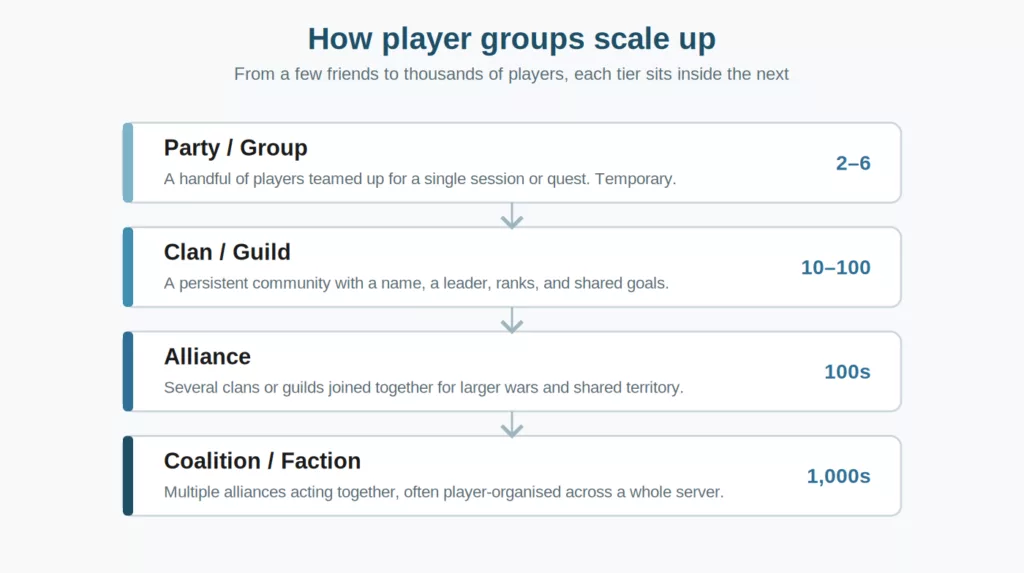
In larger games, each tier nests inside the next, from a quick party up to a server-wide coalition.
At the smallest scale is the party or group: a few players teamed up for a single quest or match, which disbands afterwards. Above that sits the clan or guild, a permanent community you belong to. In bigger strategy games, clans then band together into an alliance to fight larger wars. And at the very top, alliances sometimes cooperate as a coalition or faction that can span an entire server. Not every game has all four tiers, but the pattern is common enough to be worth recognising.
What’s inside a clan: roles and shared tools
Whatever a game calls its groups, most of them are organised in a similar way: a chain of command and a set of shared tools that make playing together work.
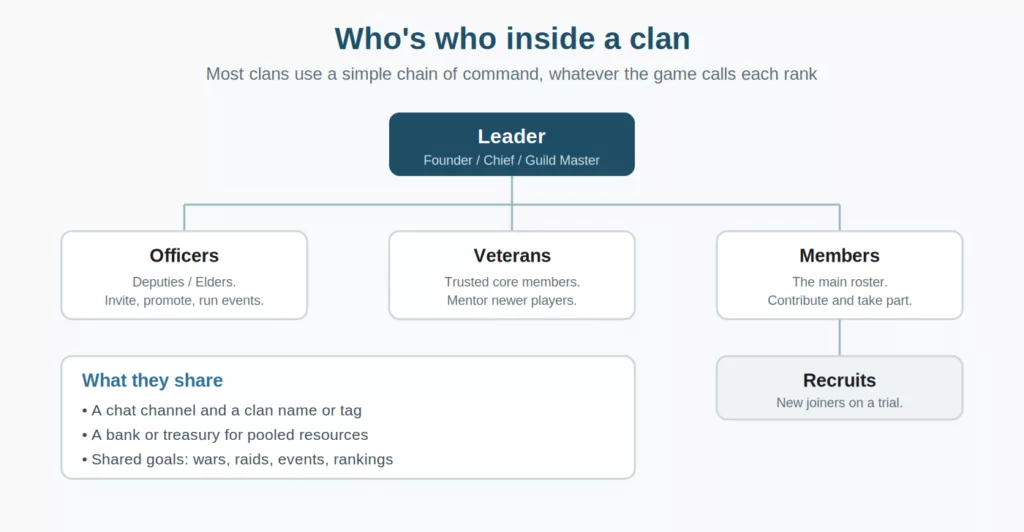
Ranks vary in name from game to game, but the structure is usually some version of this.
The ranks
At the top is the leader, the player who founded the group or inherited it, often called the chief, guild master or president. Below them sit officers, trusted deputies who can invite new members, promote people, and organise events, taking some of the management load off the leader. Then come the regular members, the bulk of the roster, and often a recruit or trial rank for new joiners who have not yet proved themselves. The names change between games, but this leader-officer-member structure is close to universal.
The shared tools
The thing that makes a clan more than a friends list is its shared infrastructure. Almost every clan has a private chat channel where members coordinate. Many have a bank or treasury where players pool resources, gear or currency for the good of the group. There are usually shared goals built into the game, such as clan wars, cooperative raids, tournaments and group rankings, that nobody could tackle alone. That combination of communication, shared resources and common objectives is what turns a list of names into a team.
Why join a clan in the first place?
Joining a group is optional in most games, and plenty of people play happily on their own. But clans exist because they make games better in ways that are hard to get solo.
- Access to group content. Many games lock their biggest, most rewarding activities behind group play. Raids, clan wars and large-scale battles simply cannot be done alone.
- Faster progress. Shared resources, advice from experienced members and group bonuses all help you advance more quickly than you would by yourself.
- People to play with. A clan means there is usually someone online to team up with, which removes the friction of finding a group every time you log in.
- Learning and improving. Newer players pick up strategies far faster with veterans to learn from, and most good clans actively mentor recruits.
- The social side. For a lot of players, the community is the main reason they keep playing. Clans are where online friendships form, and many long outlast the games that started them.
How clans and alliances work in real games
The clearest way to understand these systems is to look at how actual games use them. Strategy MMOs are the genre where clans and alliances matter most, because the entire game is built around group warfare over a shared map.
Clans in Vikings: War of Clans
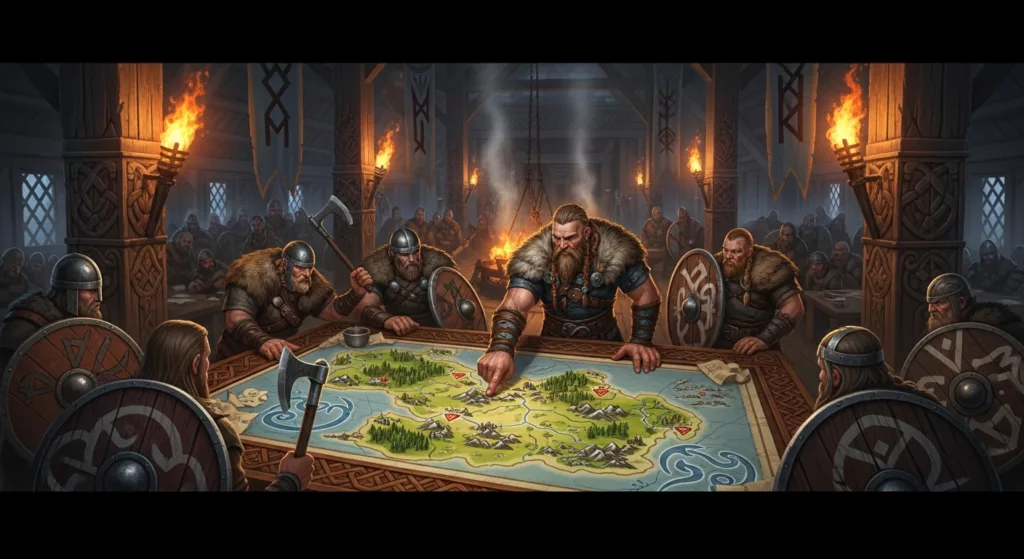
In Vikings: War of Clans, your Clan is the unit you fight, defend and grow with.
Vikings: War of Clans puts the concept right in its title. It is a Norse-themed strategy MMO where you build a town, train an army and, crucially, join a Clan. The Clan is the heart of the game: members reinforce each other’s towns when under attack, share resources, coordinate assaults on enemy strongholds, and compete together in large server-wide events. Playing without a Clan is possible but exposes you, since a lone player is an easy target for organised groups. It is a textbook example of the competitive, war-focused use of the word clan.
Alliances in Throne: Kingdom at War
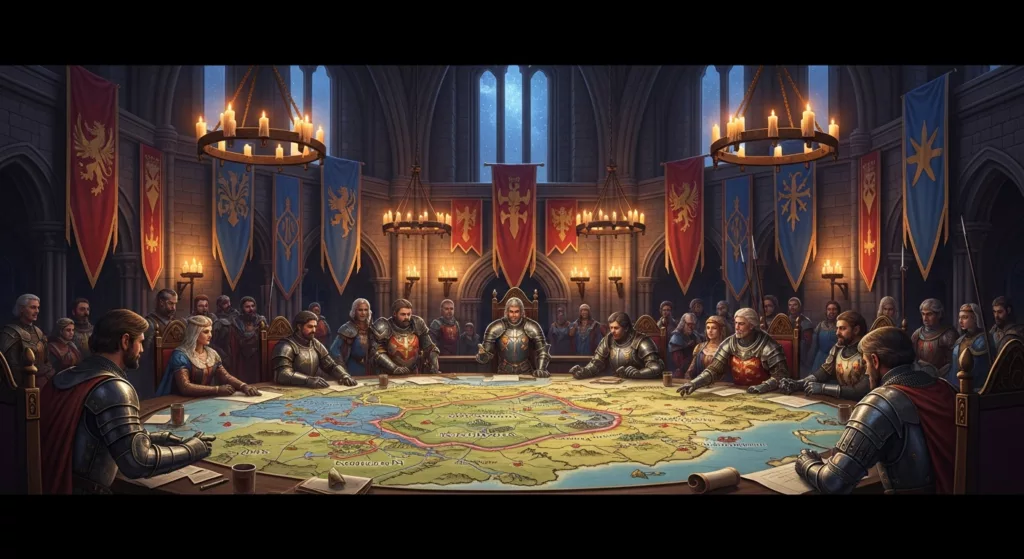
Throne: Kingdom at War uses Orders, its version of an alliance, to wage kingdom-scale war.
Throne: Kingdom at War is a medieval strategy MMO where the group system, here called an Order, functions as an alliance. Players band together to control regions of the map, defend shared territory, and fight other Orders for dominance and for control of the kingdom’s throne. The scale is larger and more diplomatic than a single clan, with coordination across many players and a strong emphasis on territory. It shows the alliance pattern in action: a big, organised group competing for control of a shared world.
These are far from the only examples. The same group mechanics drive games across the genre, from other strategy titles to collection RPGs, where clans give players a way to pool effort against shared challenges. If you want to try the concept for yourself, both of the games above are free to play.
You can explore Vikings: War of Clans and Throne: Kingdom at War, or browse more strategy games to see how each one handles clans and alliances.
How to join a good clan
Getting into a group is usually easy. Finding one that suits you takes a little more thought. Here is how to go about it.
- Use the in-game finder. Most games have a built-in browser that lists clans you can apply to or join instantly, often filtered by language, activity level or play style.
- Match your activity level. A hardcore clan that expects daily participation will frustrate a casual player, and vice versa. Look for a group whose expectations match how much you actually play.
- Check whether it is active. A clan with members who logged in weeks ago will not give you teammates when you need them. Look for recent chat and event activity.
- Read the rules. Some clans have requirements around minimum activity, contributing to the bank, or joining events. Make sure you are happy to meet them before you commit.
- Do not be afraid to leave. If a group is not the right fit, you can almost always leave and join another. The first clan you try does not have to be the one you stay in.
Frequently asked questions
What is the difference between a clan and a guild?
In practice, very little. Both are persistent groups of players who team up over the long term. By convention, clan is more common in competitive games like shooters and strategy titles and carries a competitive feel, while guild is more common in MMORPGs and carries a cooperative, social feel. Many games use the terms interchangeably, so the safest approach is to check what the word means inside the specific game.
What is an alliance in games?
An alliance is usually a larger group, often made up of several clans or guilds, formed to wage large-scale war and control territory. It is most common in strategy and empire-building games. Where a clan might be a few dozen players, an alliance can run into the hundreds, coordinating across a whole map or server.
Do I have to join a clan to play?
Almost never. Joining a group is optional in the vast majority of games, and many people play solo without any problem. That said, in team-focused games, especially strategy MMOs, joining a clan gives you access to content, protection and teammates that make the game considerably easier and more enjoyable.
What does the clan leader do?
The leader founded or inherited the group and sits at the top of its hierarchy. They typically set the rules, decide on the group’s goals, promote officers to help manage everyone, and represent the clan in dealings with other groups. In smaller clans the leader runs everything; in larger ones they delegate most of the day-to-day work to officers.
Can you be in more than one clan at once?
It depends on the game. In most games you can only belong to one clan or guild at a time, and joining a new one means leaving your current group. A few games are more flexible, such as Final Fantasy’s linkshells, which players can belong to several of at once. Always check the specific game’s rules.
What is the point of a clan bank?
A clan bank or treasury is a shared store of resources, currency or gear that members contribute to and the group can draw on. It lets a clan pool its strength, fund big projects, help out newer members, and prepare for events or wars that need more resources than any single player has. It is one of the main practical reasons clans are stronger than the sum of their members.
The bottom line
Clans, guilds, alliances and factions are all versions of the same simple idea: an organised group of players working together over time. The names carry slightly different flavours, with clan leaning competitive, guild leaning cooperative, and alliance usually meaning a larger group of groups, but the underlying purpose is shared. They give players access to bigger content, faster progress, and most importantly, other people to play with.
If you have been playing a multiplayer game solo and wondering what you are missing, the answer is usually a good clan. It is the difference between a game you visit and a game you belong to. The best way to understand it is to join one and see how quickly a game changes when you are no longer playing alone.